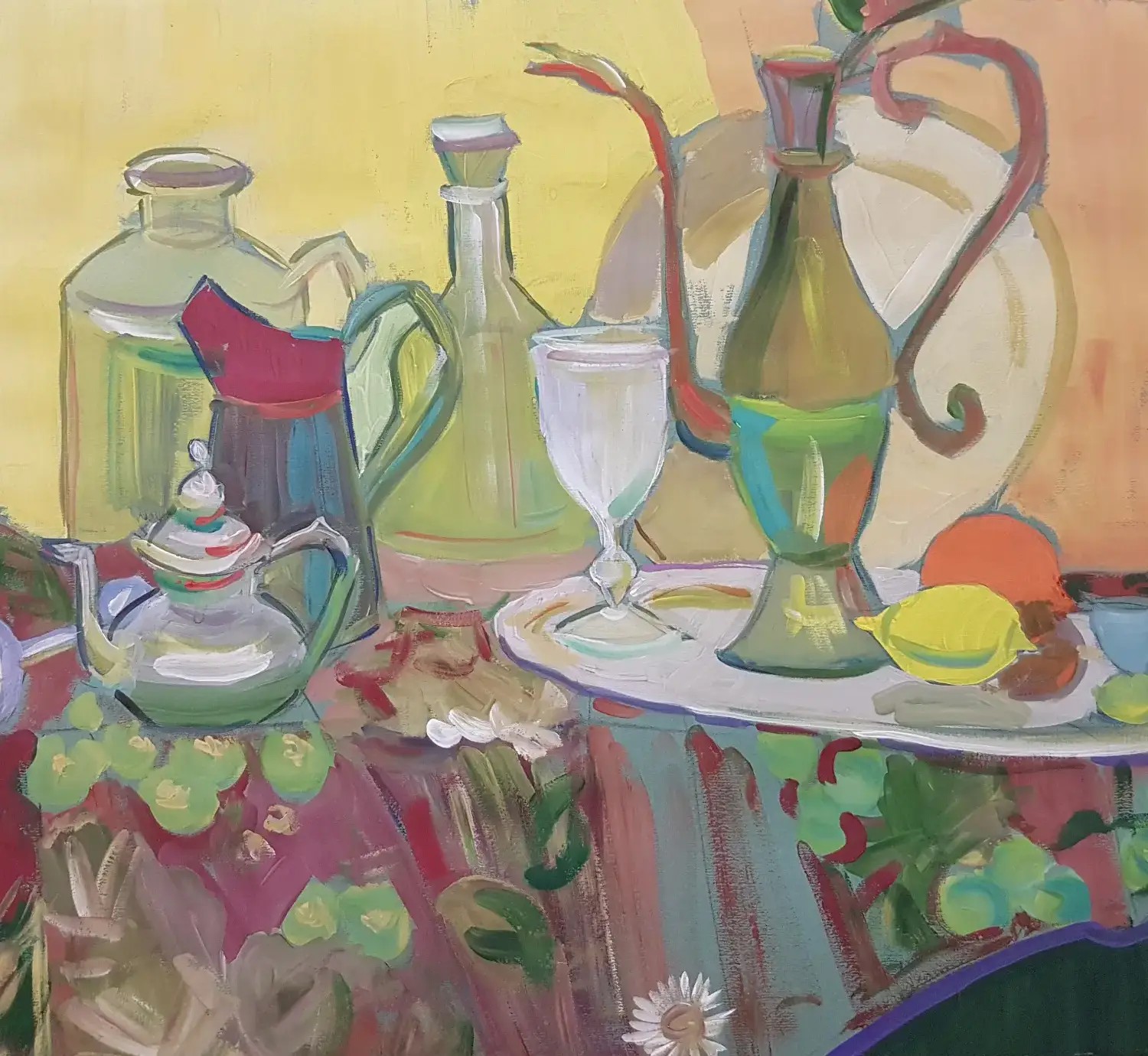
The French Academy of the seventeenth century ran on a strict order of precedence. History and mythology occupied the summit; portraiture and landscape came a rung below; and down at the very bottom, modestly, sat still life. The reasoning seemed watertight: where is the valour in copying objects that lie right under your nose and have nowhere to run? Yet one of the great paradoxes of art history is that this "lowest" of genres became the chief laboratory for the boldest technical experiments.
Consider the Dutch "breakfast pieces" of Willem Claesz Heda or Pieter Claesz. Their canvases are built on the subtlest of monochrome ranges — greys, olives, mother-of-pearl. On the table: a toppled goblet, a rumpled cloth, a pie with a bite taken out of it, and a lemon whose rind hangs in a taut spiral. That spiral was a kind of examination for the painter. One glance told viewer and patron alike whether the man could model form in the round or merely fill in outlines with diligence. Glass is harder still — it cannot be painted as a solid object. The illusion of transparency is assembled from dozens of gossamer-thin glazes, and the final sense of volume comes from highlights in thick lead white. Those strokes go on at the very last moment, in a single pass. There is simply no room for error.
Beyond technique lay a deep symbolic subtext. A skull, a guttered candle, a pocket watch, a wilting flower — the classic furniture of the vanitas, reminding us that everything passes, the viewer with his glass of Rhenish included. It was an elegant double game: the painter got to render earthly luxury with every ounce of his virtuosity while formally condemning its transience.
In time, still life took on new dimensions. Francisco de Zurbarán lined up a few earthenware vessels against a blank dark ground, and a domestic arrangement became an austere prayer. Jean-Baptiste-Siméon Chardin painted a copper cistern and a couple of onions so well that Denis Diderot devoted rapturous passages to his colour. And Paul Cézanne, who promised to astonish Paris with a single apple, made good on it: his fractured perspective and fruit forever on the verge of rolling off tilted tabletops were a direct prologue to Cubism.
That is precisely where the secret of the genre lies. Once narrative and subject stop distracting the eye, what remains on the canvas is painting itself: light, weight, texture, the density of air between objects. A copper jug is not trying to tell a story — it simply exists. And holding on to that physical, substantial existence on a flat surface proved every bit as demanding as a battle scene crowded with figures.