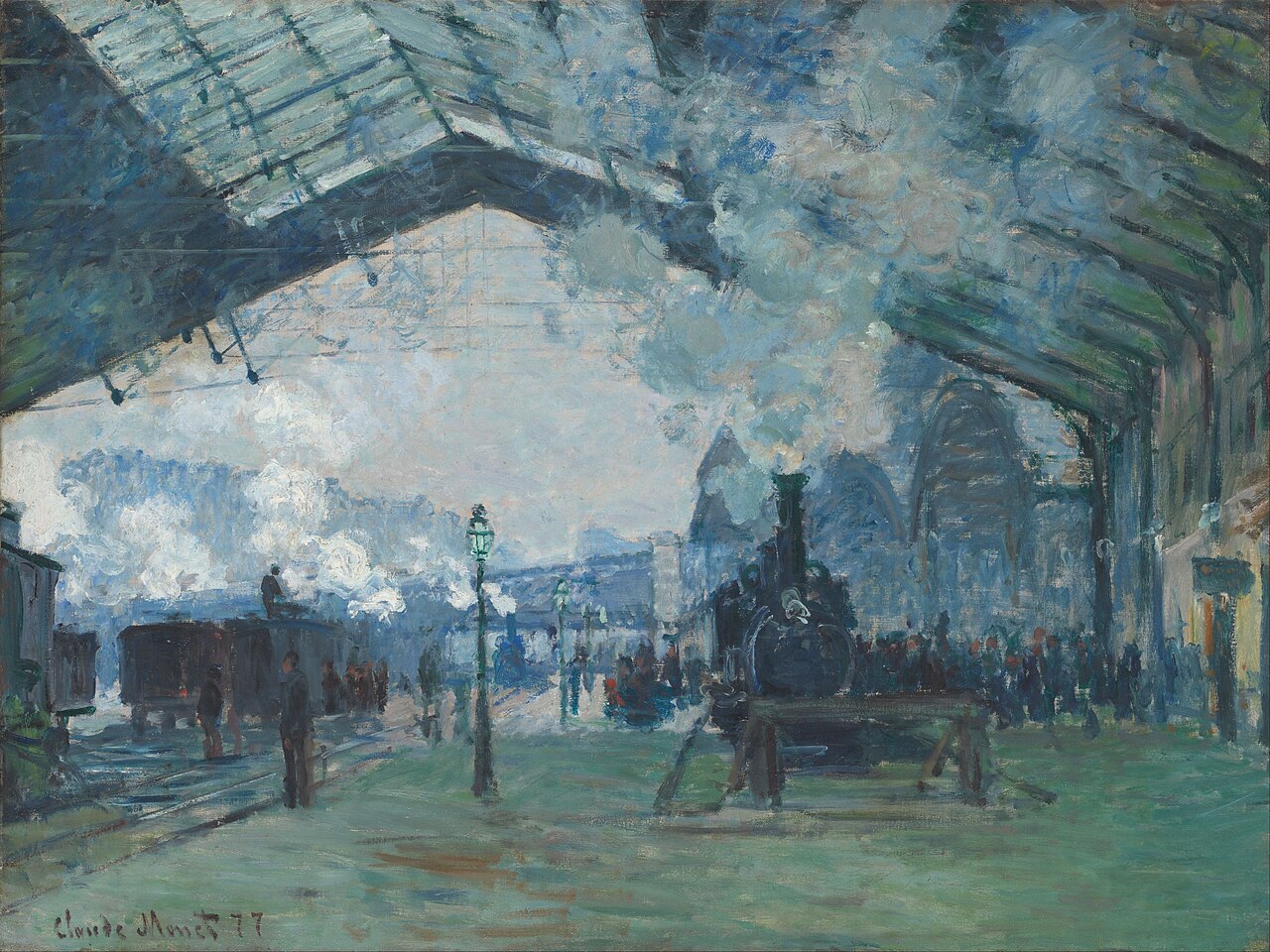
Seen through the eyes of the Paris Salon jury, many Impressionist subjects must have looked like deliberate provocation. Instead of classical heroes and biblical scenes: a train station, coal barges, factory chimneys above a river, a dull boulevard in the rain. Rather as if someone today turned up at a gallery with a series of paintings about an underground parking garage.
The first reason was programmatic. In 1863 Charles Baudelaire published his essay "The Painter of Modern Life," defending the right of the contemporary world to become a subject of art. Not just ancient heroes in togas, but ordinary people in frock coats, city streets, fashion, everyday life. Young painters seized on the idea. And modern life in the 1870s looked like cast iron, glass and steam.
The second reason was practical, and far less romantic. Paint in metal tubes, patented by John Goffe Rand in 1841, made working outdoors considerably easier. The railways played their part too, linking Paris with the suburbs where painters went to work. Monet lived at Argenteuil, Renoir came there to paint, Pissarro worked for long stretches at Pontoise. These were not merely picturesque spots for a Sunday outing: they were places where the river, the railway, industry and ordinary urban life all rubbed shoulders. Painters found their subjects right on the doorstep — and saw no reason to look away.
The third reason is the most interesting, and purely pictorial. Smoke, steam and fog transform light before your eyes: they scatter it, tint it, blur the contours of things. The air itself seems to become visible. In 1877 Monet painted an entire series at the Gare Saint-Lazare in Paris. Beneath the glass roof, steam from the engines floods the space, and the locomotives half dissolve into it. Later, around the turn of the twentieth century, he painted the Houses of Parliament in London through the fog, returning again and again to a single motif under changing light. Here the fog is not an obstacle to be waited out, but part of the subject itself.
So an "ugly place" is a category of historical taste rather than of painting. The Impressionists showed that artistic interest depends less on the object itself than on how the light falls across it and how that light shifts through the day. A factory chimney at sunset may be no less rewarding to a painter than a marble column. It is simply that the column had long been accepted as a worthy subject for art, while the chimney was still waiting for its recognition.