In conversations about art, the word "amateur" sounds almost like a diagnosis: the person tried, but fell short. The reality is more interesting than that, and the history of painting has repeatedly given us reason to question such verdicts.
Academic training is an enormous stock of ready-made solutions. How to construct a figure, where to place a reflected light, how to paint a fold of cloth so that it reads from five metres away. All of this is invaluable, and it saves years. But every stock of solutions has a side effect: the hand sometimes answers before the artist has had time to ask the question. The result is competent and solid — and at times too much like what everyone else is doing.
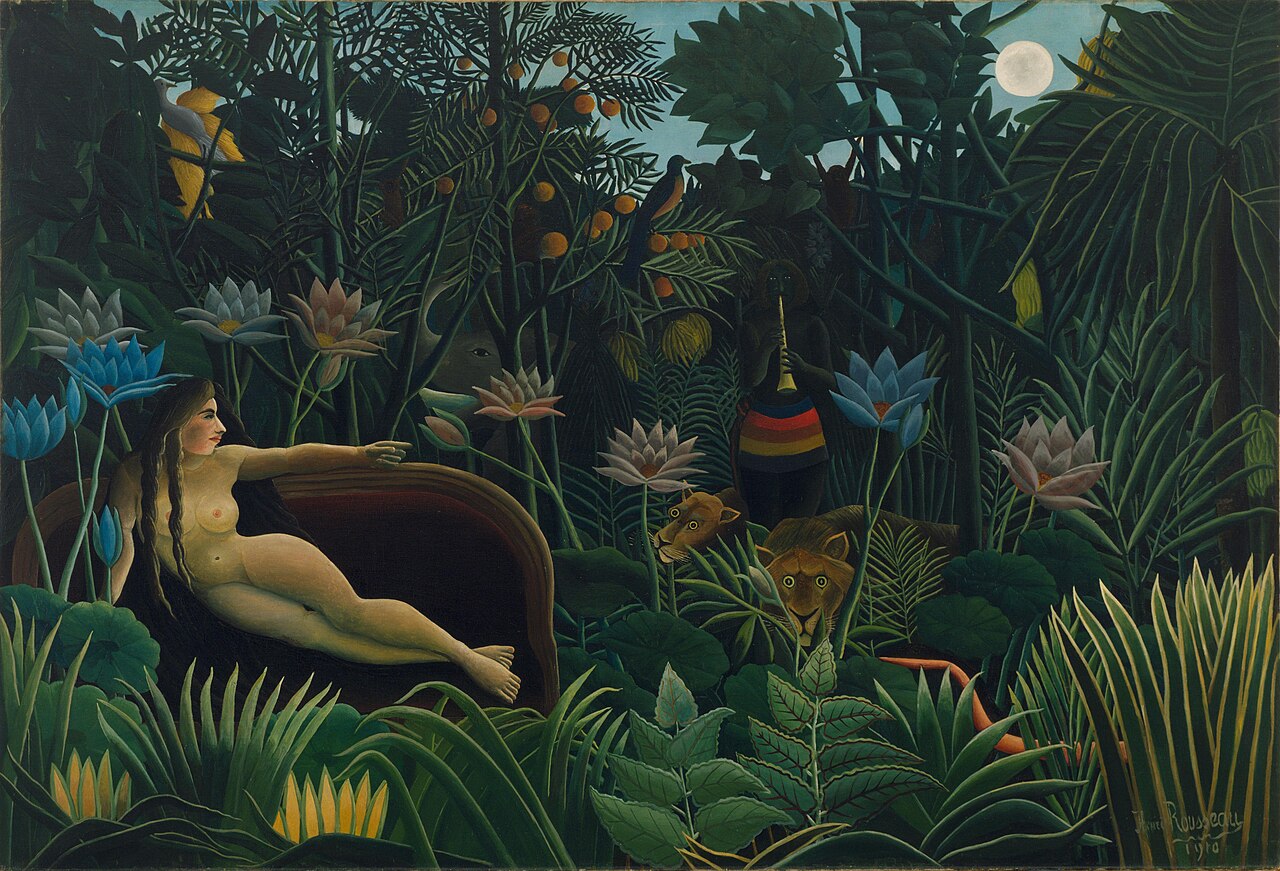
A self-taught painter may have no such filter. Henri Rousseau worked as a customs officer in Paris and painted his famous jungles without ever having set foot in the tropics: he visited the botanical gardens and studied plants and book illustrations. By the standards of academic perspective, his thickets look peculiar: the leaves arrange themselves into something close to ornament. It is precisely this flatness and decorative quality that makes them so mesmerising. In November 1908, Picasso — an artist with serious academic training behind him — threw the celebrated banquet in Rousseau's honour at the Bateau-Lavoir. It was both an act of friendly support and a kind of artistic performance staged in the bohemian world of Montmartre. Rousseau already intrigued young painters and poets, even though his work still regularly drew mockery. The banquet matters, then, not as proof of universal recognition, but as a sign that certain artists saw in his unusual manner not a shortcoming but a force of its own.
Niko Pirosmani painted signboards for the taverns of Tiflis and worked on black oilcloth, turning the dark surface into part of the image itself. Where another painter would have worked up the background, Pirosmani could simply leave the black material exposed. The result was a spare, powerful image — with no need to fill in every patch of the canvas. Anna Mary Robertson, known to the world as Grandma Moses, took up painting in earnest late in life, when arthritis made embroidery impossible. Her scenes of rural life eventually became widely known and entered museum collections.
Let's not romanticise this, though: most amateur work remains just that, and a lack of training saves no one on its own. The point is not ignorance. It is that sometimes fewer intermediaries stand between the idea and the canvas — familiar rules, absorbed techniques, the fear of getting it wrong. A person simply paints what they see and feel, unaware that such a thing "isn't done". And now and then that turns out to be the most interesting thing of all.