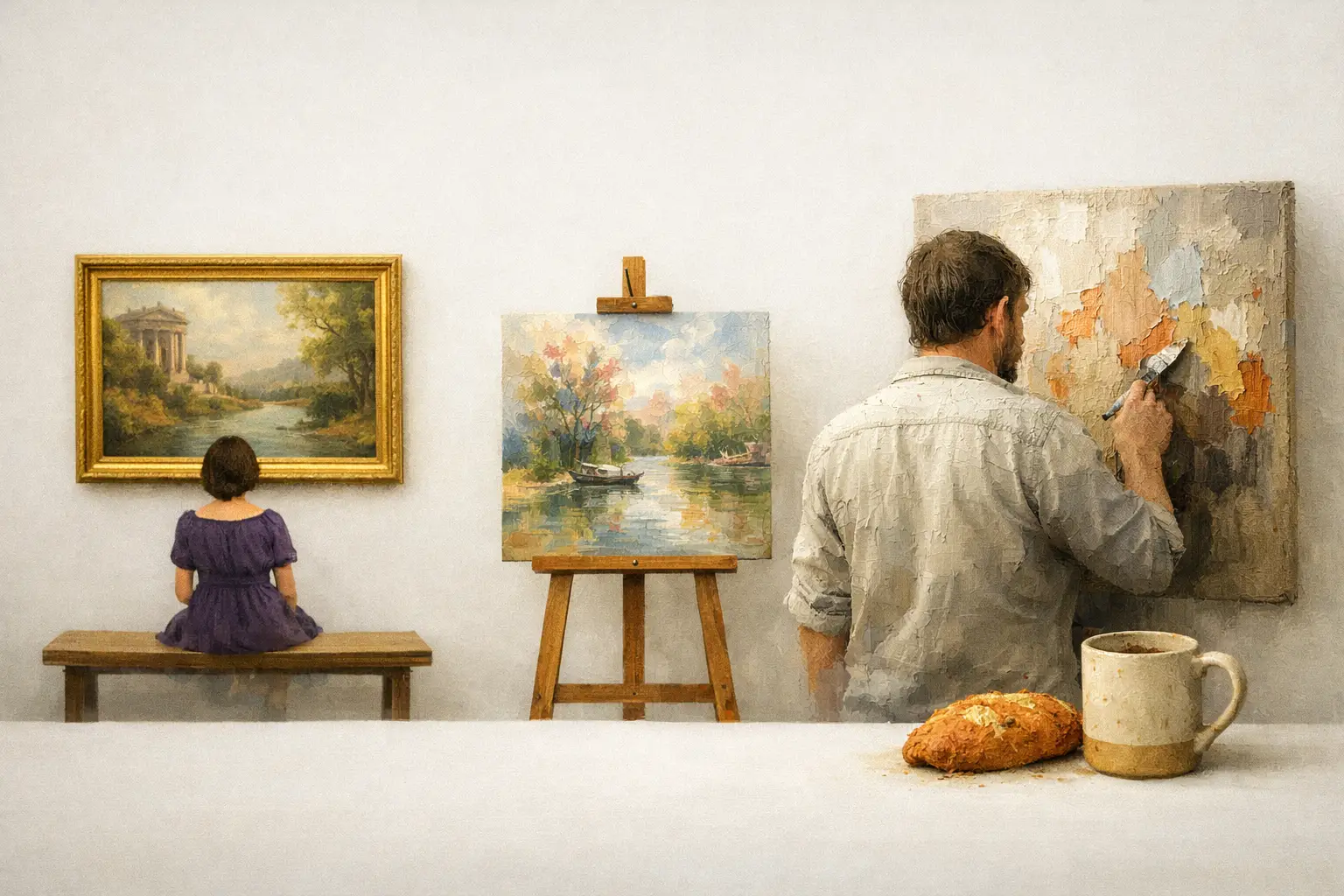
The mechanism of perception in classical art, Impressionism, and contemporary Slow Art is indeed the same. Any quality 19th-century canvas in a museum grounds us, makes us study brushstrokes, and gives a sense of silence. But there is one fundamental difference between old classics and contemporary art. It lies in the context of time and intention.
When Impressionists went out to paint en plein air, they used the cutting-edge technologies of their era. A painting was almost the only way to capture a visual image. Today, when everyone has a powerful camera in their pocket and neural networks generate perfect images in three seconds, choosing oil paints is a conscious rebellion. Painting in oil today means choosing the most inefficient, long, and expensive way to create an image. And it is precisely in this “inefficiency” that new value is born.
Old masters strove for the ideal, trying to overcome the material’s limitations. Contemporary Slow Art, on the contrary, celebrates materiality and handcraft. In a world where digital gives flawless smoothness, the viewer desperately seeks traces of the human: a living, sometimes deliberately careless palette-knife stroke that cannot be repeated, mistakes, roughness, drips of paint. This resonates with how we now choose craft bread over factory-made or rough handmade ceramics with the potter’s fingerprints instead of perfect but faceless mass-produced cups.
Classics in a museum are great but detached art. They belong to eternity. Contemporary Slow Art is utilitarian in the noblest sense. It is created for a specific person and a specific space. Buying a painting from a living contemporary means acquiring not just an interior object but part of the artist’s personal time, mental state, and energy. Any good painting brings us back to ourselves, but contemporary slow art does it here and now, acting as a living counterbalance to our crazy age of speed.