In the early nineteenth century a newcomer arrived on the painter's palette: chrome yellow. Based on lead chromate, the pigment appeared in the early 1810s, not long after the chemist Louis Nicolas Vauquelin identified the element chromium. The resulting colour was dense, brilliant, almost brazen. Artists were quick to appreciate its punch and covering power, though in time it emerged that some varieties of the pigment were prone to darkening.
J. M. W. Turner was among the first to take the new colour up with enthusiasm. He approached materials as an experimenter in general: testing, mixing, gambling with permanence for the sake of effect. In his hands yellow flooded sky, water, air and mist all at once. Critics reacted roughly the way people react to a man who turns up at a funeral in orange: Turner was accused of "yellow fever", his canvases were described as jaundiced, his painting likened to a disease. Works such as The Slave Ship or the late Venetian views really are built so that light matters more than any object in it.
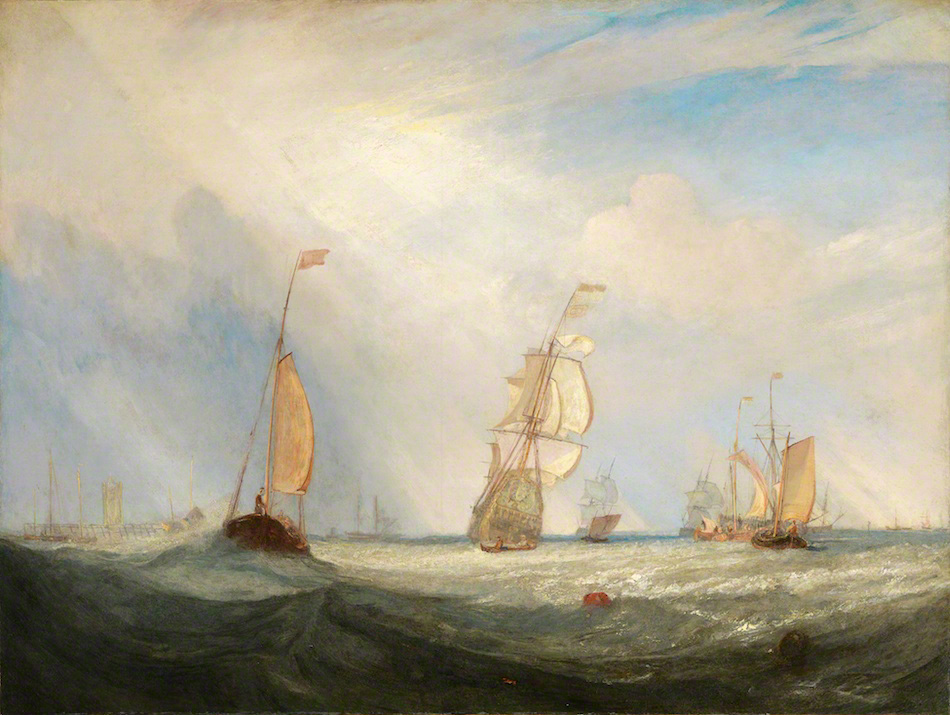
There is a classic Turner anecdote. In 1832, at the Royal Academy exhibition, on the day when artists were allowed to touch up their work before the opening, his sea piece hung next to a painting by Constable. Turner stepped up and added a bright red daub to his own canvas — a buoy. Constable, according to contemporaries, remarked that Turner "has been here and fired a gun." A single dot of colour outplayed an entire painting.
Turner read theory, too: he went through the English translation of Goethe's Theory of Colours and in 1843 produced a pair of paintings — one on darkness, one on light — responding to the German thinker's ideas about colour and light.
And then came the decisive part. In 1870–71, Claude Monet and Camille Pissarro, who found themselves in London during the Franco-Prussian War, saw his work. Historians still argue about how directly Turner influenced them, but his preoccupation with light, atmosphere and the dissolution of form was certainly not something they could have missed.
Fashions in colour are rarely born in magazines. Sometimes all it takes is one stubborn person who isn't afraid of a new tin of paint.